



Al-Oqilat routes: The Al-Oqilat were caravan leaders and guides. Their presence in any caravan gave it the right of overland passage and removed suspicion of hostile intentions; their caravans were rarely robbed. The routes they followed from Al-Qassim differed between summer and winter. In summer, caravans needed large quantities of water for travelers, camels, and horses, so they followed a chain of water sources even when it lengthened the journey. In winter, camels could go much longer without water, allowing caravans to shorten both the route and the number of watering stops. The following are some of the routes they traveled.
Buraidah–Kuwait Route
Buraidah (Al-Jardah) – Al-Tarfiyah – Al-Asyah – Bir Al-Naqa – Al-Ajardi – Bir Al-Thumami – Al-Buraikah Wells – Al-Saba Wells – Wadi Al-Batin – Al-Ruq‘i – Kuwait – Al-Zubair – Basra.
Al-Oqilat routes—the journey began at Al-Jardah in Buraidah. When the Al-Oqilat prepared to depart, their families, and indeed all the people of Buraidah, grieved at parting from relatives, companions, and loved ones. One poet said:
When Aqeel's caravan departs, we come to bid farewell; / How sorrowful our condition from the moment they leave.
After our loved ones go, Al-Jardah falls still; / Parting from them is hard, and the soul fills with worry.
O heart, do not weep, for lamentation can be heard; / Our enemies will ask: What makes them weep today?
Here was the people's camp, where the tribal mark remains; / Here was the night camp, from which the men traveled on.
Their road to honor and standing is made / With the sword and the serving platter when they journey.
How often Aqeel answered while the sword flashed; / Against their foes, honor was theirs when they resolved to act.

The Al-Oqilat at their midday halt, performing the Dhuhr prayer after Al-Mudarraj in northern Al-Qassim. May God have mercy on them.

Pilgrims from Al-Qassim in 1350 AH


Aqeel men on their way to Iraq, passing along the pipeline. The photograph shows Aqeel men and foreigners exchanging greetings.
O riders, you who rise from among Aqeel, / Upon the pack saddles of tall, fully laden camels.
Leaving Jamshat Buraidah, they set forth unharmed; / They loosened the bridles of mounts that carried hardship far away.
In the afternoon they descended from the dunes of Al-Uraiqa, / Along the edge of Al-Kharaim toward the dry grasses of Al-Thumami.
At dawn they stopped at Al-Hafr, then traveled by night, / And spent the night at Al-Ruq'i, to the left of the rugged ground.
Buraidah–Baghdad Route
Buraidah – Al-Tarfiyah – Dhaidah – Al-Zubairah – Birkat Zubaidah – Al-Bida – Linah – Qulban Hufairah – Al-Nazim – Birkat Al-Uqbah
Birkat Zubaidah, at the end of Shaghiyah, running from east to west.

Al-Bida Well (Zubaidah Well), one of the abundant water sources frequented by the Al-Oqilat.

Buraidah–Amman summer route: Buraidah – Al-Shiqqah – Dhahrat Al-Batin Ablaq – Qusayba – Al-Sa‘irah – Al-Ajfar – Zarud Well – Al-Khuzaimiyah Well – Waseet Well – Turbah – Al-Amaylis Well – Al-Usayli‘ Well – Khab Aqeel at Al-Hayyaniyah – Umm Junaih Well – Ushaiqir Wells – Adhfa Wells – Adhfa – Khu‘a – Al-Jawf Qara – Al-Nabk – Al-Fayyad – Al-Isawiyah – Khudair Well – Al-Umari – Amman.
Routes varied according to where the Al-Oqilat bought their camel herd; the principal route began in Buraidah.
Al-Shiqqah watering place:
One poet said:
Welcome to Aqeel whenever they arrive, / Their camels swaying into view at sunrise over Al-Shiqqah.
Mounted on tall, dependable she-camels, / Their saddlebags splendid with beautiful tassels.
———————-
Watering place
Qara watering place:
The distinguished poet Mored Qara said:
The maidservants continue to race toward its bucket, / As dogs once raced toward the waters of Qaraqir.
One poet said:
We made for Al-Jawf and Al-Jawbah / When we resolved to journey west.
O God, grant us the saddle of a fine, proven camel, / One of the mature bearers of saddlebags.
Sweeter than a young camel and the riding of it, / Among the baggage camels of generous hosts.
Al-Qassim–Amman Route in Winter
There were many routes, each chosen according to where a herd was located or purchased. The following are some examples.
Buraidah – Al-Tarfiyah – Al-Asyah – Didaydah – Zarud – Turbah – Al-Hayyaniyah – Adhfa – Khu‘a – Al-Jawf – Al-Isawiyah – Al-Umari.
Al-Qassim to Palestine and Egypt in winter: Buraidah – Qusaiba – Al-Kahfah – Sumaira – Qasr Al-Ashrawat – Al-Tawilah – Al-Ramadi – Al-Hayawi – Baqra Latif – Al-Ula – Al-Muwailih – Hafr Maan – Al-Ghor – Jordan Valley – Palestine. Alternatively, from Al-Muwailih the route went to Taba – Qatiya – Al-Arish – Bir Al-Abd – Al-Duwaydar – Al-Qantarah Al-Sharqiyah.
Al-Ghor is the Jordan Valley between Amman and Jerusalem. It is a three-day journey in length and less than half a day across. A river runs through its length, beginning at the Sea of Galilee and emptying into the Dead Sea, also called the Lake of Lot. One poet said:
“I find myself living, after Najd, in the lands of Al-Ghor and Tihamah.” The poet said of Wadi Al-Ghor: “For a time I was a man living in Al-Ghor, and at another time in the highlands—yet neither avails nor reveals.”
Sometimes I turn my gaze toward Tihamah; / At others I turn it longingly toward Najd.
Al-Qassim to the Levant: Buraidah – Qusaiba – Zarud – Turbah – Al-Hayyaniyah – Al-Thughur – Adhfa – Mughaira – Qara – Al-Jawf – Wadi Al-Sirhan – Al-Hammad – Al-Wuryan – Al-Mat – Dumair – Al-Ghouta
Qusaiba watering place
Qusaiba has plentiful water and good grazing. Each caravan selected its route according to its destination and the place where its herd had been bought. The herds grazed as they traveled toward their appointed route. There were many roads, but the principal one was the road with reliable water.
Qusaiba has a well-known place in ancient history. Sources state that it was land belonging to Banu Tamim, or, according to another account, Banu Imru Al-Qais. A famous battle at Qusaiba was known as the Day of Uwarah.
Al-Asha said: ‘You shall be among the aligned forebears, / And recite of Banu Zurarah—sons of a people slain / On the Day of Al-Qusaibiyah at Uwarah.’

This work was compiled and prepared by site founder Abdullatif bin Saleh Al-Wuhaibi.
Zarud watering place: Zarud was a famous, ancient water source on the route of pilgrims coming from Iraq to Makkah. One poet said: ‘I speak as we passed Zarud one evening, / While our mounts carried us toward Najd. / Peace be upon the people of Baghdad, for with my journey / I increase the distance between me and their land.’

Wasit watering place

Turbah watering place, located where the Al-Thuwayrat dunes meet Al-Nafud Al-Kabir.

Al-Amaylis watering place, northwest of Jubbah. During Abdul Latif Al-Wuhaibi's visit to Sheikh Aafat bin Dibshi bin Muhammad Al-Salmani Al-Shammari, the sheikh said that he used to see those who came to the well. Among the Aqeel men he remembered were members of the Al-Jarboa, Al-Zimam, and Al-Rakaf families, as well as many other Al-Oqilat men.
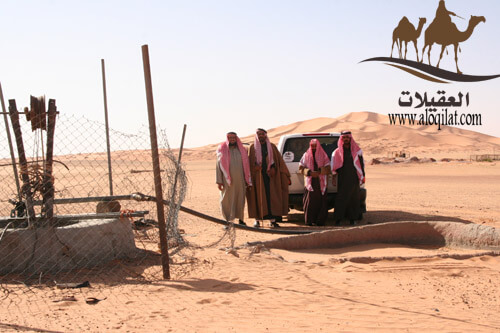
Al-Usaila watering place

Al-Hayyaniyah watering place
Al-Hayyaniyah watering place belonged to the Al-Shulqan branch of the Shammar tribe. Historically, this water source was known as Hayyan.
The poet said:
They departed from Hayyan after a stay, / And after suffering endured by your weary heart.

Khabbat Aqeel
Prince Ibn Musaed of Hail appointed a man northeast of Al-Hayyaniyah to maintain security. He told the Al-Oqilat leader that Ibn Musaed wished to see him, so the leader halted the caravan at this dune and the Al-Oqilat travelers camped near Al-Hayyaniyah. Their caravan stretched like broken clouds, and the dune came to be called Khabb Aqeel because of their great number, until their leader and senior merchants returned from the Prince of Hail.

Umm Junaih watering place

Adhfa watering place
The Al-Oqilat poet Abdullah Al-Munif said while heading toward Adhfa:
O my young she-camel, though Munaif has wearied you, / You will reach Adhfa in a single night.
Your destination is a pool in summer, / Or a rain cloud whose torrent has swelled.
Turn toward Shammar, who honor the guest, / When every other recourse has failed.
With Al-Jubaili, spirits lift, / While you rest, O Shuailah.

Qulaib Khudair watering place
Guide: Mahdi Salem Al-Sharari

Al-Isawiyah watering place
This mosque was built near the watering place and is more than seventy years old. Its emir at the time was Shaya bin Rabah Al-Tamimi, from 1345 AH until approximately 1390 AH. Guide: Nafi Salim Khamis Al-Sharari.

Wadi Al-Sirhan extends from the north toward eastern Jordan and served as an Al-Oqilat passage to Jordan, Syria, and Palestine.

Wadi Al-Sirhan in 1336 AH, with the army of Faisal bin Hussein passing through.

Al-Nabak / Umm Qasr watering place
A small palace stands beside the well; today it is enclosed by a fence.

Wadi Al-Ghor extends from the Dead Sea to the Gulf of Aqaba. Its warm winter climate and grazing lands made it a winter gathering place for the Al-Oqilat.

Dangers of the Route
The Al-Oqilat faced difficult situations, including:
1. Failing to find water sources
2. Severe desert storms
3. The blazing sun
4. Highway robbers and their varied, unexpected methods of treachery
Despite all these dangers, the Al-Oqilat acted with wisdom and experience. On one journey toward the Levant, Mansour Al-Abdulrahman Al-Shuraidah became suspicious that highway robbers were nearby. He told his companion, ‘Put water in the kettle,’ meaning that he wanted him to make tea. His companion replied that the Al-Oqilat caravan had already set out, but Mansour repeated: ‘Put water in the kettle.’ This delayed them by more than two hours. When they later drew close to the caravan, robbers were firing upon it. Mansour told his companion: ‘Stay close and protect my back.’ He began firing at the robbers, killing several; the rest surrendered because of his courage and the surprise of being attacked from behind. Mansour then ordered a fire lit to signal that the danger had ended and allow the caravan members to regroup nearby. Thus the phrase ‘Put water in the kettle’ became proverbial. Sheikh Ibrahim Al-Sulaiman Al-Jarboa was likewise proverbial for his complete knowledge of water sites, wells, and routes. One must remember that the Al-Hammad Desert is a vast wilderness where trails are easily lost, largely uninhabited and with only rare water sources. Its dryness and desolation are not unusual in many parts of the Arabian Peninsula. Sheikh Dhaifallah explained that the term refers to deserts, wildernesses, and barren land without water or vegetation. Since ancient times it has been applied to the Arabian Peninsula, as well as to people who inhabited that land and made it their home. The Arabian Peninsula's physical and geographical position has shaped its significance: its interior is surrounded on every side by deserts and sands. This made the Peninsula a formidable fortress that prevented outsiders from occupying it and extending their control and influence. Its inhabitants consequently remained free in their affairs through the ages. Men renowned for knowledge of the routes included Ibrahim bin Sulaiman Al-Jarboa, Ibrahim Al-Ali Al-Rashoudi, Abdulaziz Al-Hammad, Sulaiman Al-Mutawa, Muhammad Abdulaziz Al-Mudaifer, Al-Noudali, and Al-Hajras.
See Ibrahim Al-Maarik, Al-Oqilat of Buraidah.
Compiled and prepared by Abdullatif bin Saleh Al-Wuhaibi.
You must be logged in to post a comment.