


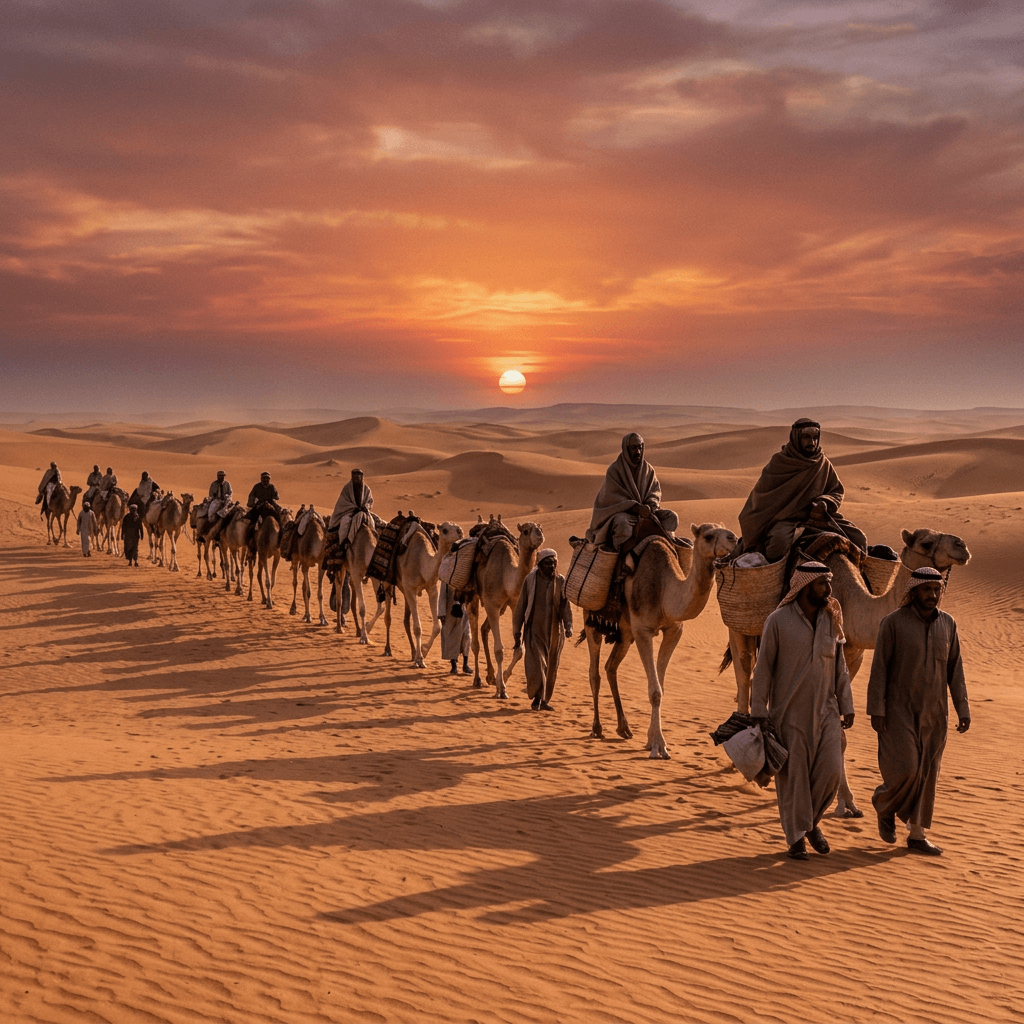
A comprehensive account of the Al-Oqilat journey—from their origins and routes to the foundations of their trade and their enduring achievements.
Origins: Journeys Across Continents
The Al-Oqilat were one of the best-known trading communities of the Arabian Peninsula. Setting out from Al-Qassim, they travelled across a vast geographic range. Their journeys extended beyond neighboring regions to Iraq, the Levant, and Egypt, and as far afield as India and China. They formed an economic and cultural link between societies, helping towns grow and carrying knowledge and experience from one people to another.
Caravan Routes and Water Sources
The Al-Oqilat were trusted caravan leaders and guides. Their routes changed significantly with the seasons. In summer they took longer routes in search of the water needed by travelers and camels, whereas in winter they could take shorter routes because water was less urgently needed. Their caravans usually departed from Al-Jarradah in Buraidah and followed established routes, including:
📍 Buraidah–Kuwait and Iraq Route:
Al-Jarradah, Buraidah ← Al-Tarfiyah ← Al-Asyah ← Bir Al-Naqa‘ ← Al-Ajardi ← Bir Al-Thumami ← Al-Buraikah Wells ← Al-Saba‘ Wells ← Wadi Al-Batin ← Al-Ruq‘i ← Kuwait ← Al-Zubair ← Basra.
📍 Buraidah–the Levant, Palestine, and Egypt Route:
They travelled through Wadi Al-Sirhan or Wadi Al-Ghor, whose climate is warm in winter, passing well-known water sources and stopping places such as Qusayba, Zaroud, Turbah, Al-Hayyaniyah—near which a place was named “Khabb Aqeel” because of the large number of Al-Oqilat who gathered there—Adhfa, and Al-Jouf, before reaching Damascus, Jerusalem, or Egypt.
Hazards of the Road and Skilled Leadership
Al-Oqilat journeys were no pleasure trips. They faced severe dangers, including lost or depleted water sources, fierce desert storms, scorching sun, and bandits.
Thanks to their skill and judgment, their caravans were rarely plundered. One of the best-known examples of their courage and resourcefulness is the story of the Al-Oqilat merchant Mansour Abdulrahman Al-Shuraidah, who sensed danger and delayed setting out on the pretext of making tea—“put water in the kettle.” This enabled him to surprise and defeat the bandits who attacked the caravan from behind, and his words became a popular saying.
Several Al-Oqilat guides became renowned for their precise knowledge of routes and water sources in the barren desert, including Ibrahim Al-Sulaiman Al-Jarbou‘, Ibrahim Al-Ali Al-Rashoudi, and Abdulaziz Al-Hamad.
Foundations of Trade and Commerce
The Al-Oqilat built their trade on honesty and trustworthiness. They dealt in camels, agricultural produce, and purebred Arabian horses, whose bloodlines they knew in great depth. Their journeys also gave rise to practical food traditions created as provisions for the road, such as “Qurs Aqeel.”