


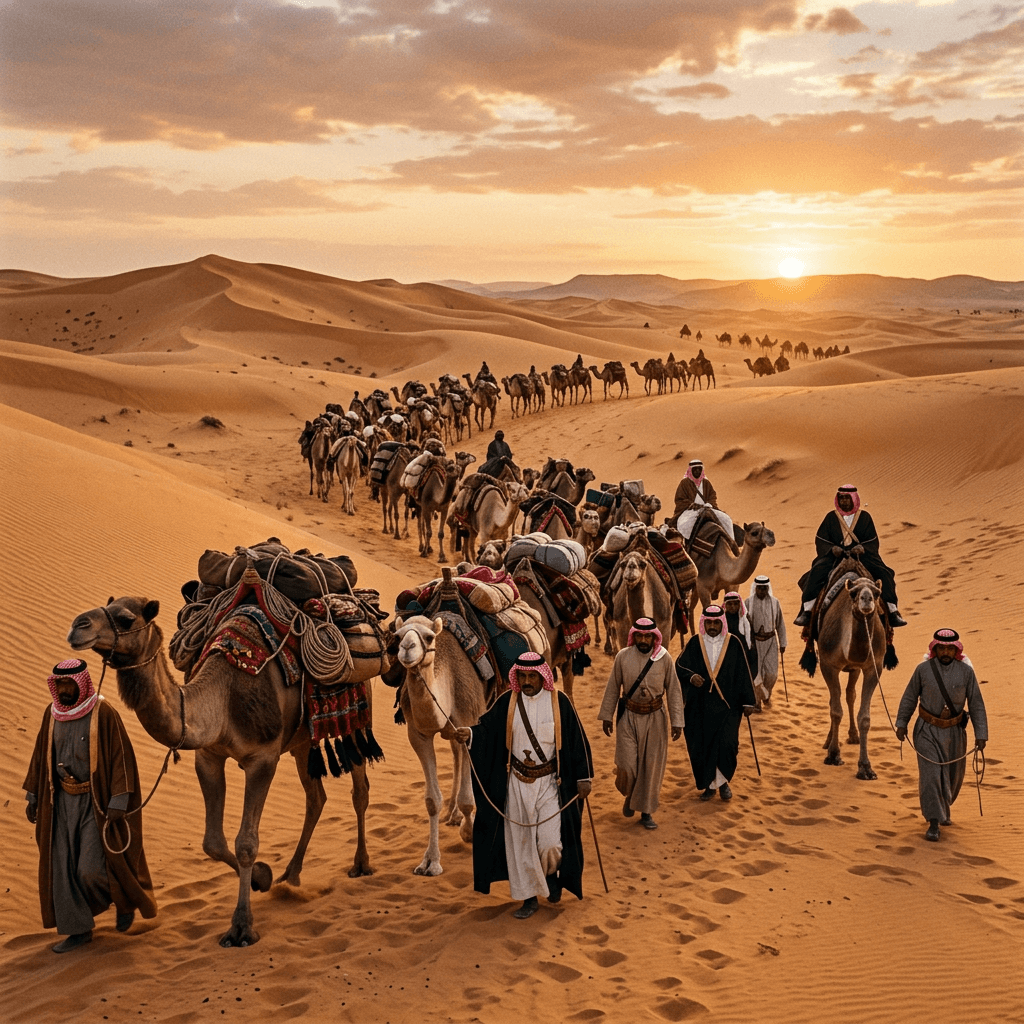
A window into Al-Oqilat life: their equipment, terminology, and exemplary character.
Who Were the Al-Oqilat?
“The Al-Oqilat were merchants from Najd, especially Al-Qassim—most notably Buraidah and its surrounding villages, Unaizah, and the other parts of the region. They did not belong to one particular tribe or family. Rather, they came from the settled communities of Al-Qassim and the tribes of Najd, united by the trading profession known as Aqeel. They dealt primarily in camels, as well as horses, sheep, and general merchandise, trading between Najd, Iraq, the Levant, Jordan, Palestine, Egypt, Sudan, India, southern Turkey, western Iran, southern Africa, and the Maghreb.”
The Difference Between an Aqili, a Ruhaili, and a Jammal:
- Aqili: Primarily a camel and horse merchant who owned capital, drove herds across countries, and served as leader of a fully organized trading journey.
- Ruhaili: A hired carrier, or a trader who bought merchandise in neighboring countries to sell in Najd—in effect, a freight transporter.
- Jammal: A camel owner who used the animal for ordinary daily needs such as carrying water and firewood.
- Ra‘i Al-Shidad: A man who rode his camel on raids and in war.
Essentials for Al-Oqilat Journeys
Long journeys required precise, carefully planned equipment to keep the caravan safe and ensure the success of its trade:
🐪 Riding Equipment and Camel Tack:
Shidad pack saddles, hawdaj litters, khuruj saddlebags, hadaij, misammah, and ghabit, together with camel tack such as halters, bits, hobbles, and restraints.
💧 Watering Equipment:
Waterskins, large water carriers, well ropes, pulleys, buckets, troughs, and the equipment needed to draw water from wells for the camels.
☕ Coffee and Tea Utensils:
Coffee-roasting pans, the nijr mortar, dallah coffee pots, cups, kettles for boiling and pouring, and the traditional sallā‘ah flask.
⛺ Camping and Cooking Equipment:
Canvas tents, bedding, cooking pots, serving dishes, ladles, and camp tools such as spades and tent ropes.
Al-Oqilat Terminology
Roles Within a Caravan:
Aqili: The merchant who owned the capital. Ra‘i—the Herder: The person responsible for tending the camels. Mulhaq—the Assistant: An attendant and helper. Qahwaji—the Coffee Maker: The person responsible for coffee and the guest tent. Tabbakh—the Cook: The person responsible for provisions and meals. Khawi—the Tribal Escort: A guide and companion from the tribe through whose territory the caravan was passing.
Terms Used on the Road:
Gharrabu—“They headed west”: They travelled toward the Levant, Jordan, and Egypt. Sharraqu—“They headed east”: They returned to their homeland in Najd. Addu—“They crossed”: They crossed the Jordan Valley. Shira‘: A tent; figuratively, the term could also mean a merchant. For example, “fifty shira‘ travelled with him” meant fifty merchants with their tents.
Terms for Rest Stops:
Mudhaha—Midday Stop: A late-morning resting place where the caravan ate its main daytime meal. Mu‘ashsha—Evening Camp: The evening stopping place where the caravan ate dinner and spent the night.
The Character of the Al-Oqilat and What Was Said of Them
The Al-Oqilat were known for honesty, trustworthiness, chivalry, selflessness, and the broad outlook gained through contact with many peoples. They read the classical Mu‘allaqat poems, some spoke foreign languages, and constant travel never weakened their religious commitment. Merchants in the Levant trusted them so completely that they entrusted them with thousands of gold pounds without written contracts or receipts.
Enduring Proverbs and Sayings:
“It is firmly established that the Al-Oqilat were among the most cultured men of Najd and among the most dedicated in their pursuit of knowledge.”
— Traveller Maurizi